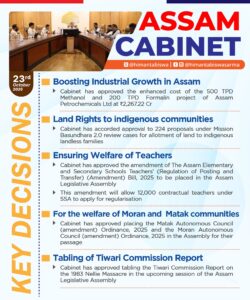
Assam Government to Table Long-Awaited Tiwari Commission Report on 1983 Nellie Massacre
Guwahati, October 24, 2025 – The Assam Cabinet has approved the tabling of the Tiwari Commission Report in the upcoming Assam Legislative Assembly session, scheduled to begin on November 25, 2025. Chief Minister Himanta Biswa Sarma announced this decision on October 23, 2025, marking a significant step toward addressing one of the state’s most tragic historical events—the 1983 Nellie Massacre—after over four decades of the report remaining unreleased.
Historical Context and Commission Details
The Tiwari Commission, officially the Commission of Enquiry on Assam Disturbances, was established under the Commissions of Inquiry Act, 1952, and chaired by retired Justice Tribhuvan Prasad Tewary. Formed in response to the Assam Agitation (1979–1985), a movement led by the All Assam Students’ Union (AASU) and All Assam Gana Sangram Parishad (AAGSP) against the influx of foreign nationals, the commission submitted its report in May 1984. The agitation culminated in the Nellie Massacre on February 18, 1983, when an estimated 2,000 to 3,000 people, mostly Bengali-speaking Muslims, were killed in a single day in Nagaon district.
Spanning over 500 pages, the report provides a detailed analysis of the agitation’s causes, progression, and aftermath. Key findings include:
- Causes: The agitation began with the Mangaldoi Lok Sabha by-election in 1979, triggered by concerns over electoral rolls inflated by illegal immigrants, leading to widespread protests.
- Violence Statistics: Between 1979 and 1983, the commission documented 1,819 murders, 3,674 assaults, and numerous arson incidents, with the Nellie Massacre as a peak event driven by communal tensions.
- Government Response: The report criticizes the inadequate response of both central and state governments, noting 718 communal incidents and a failure to prevent escalation during the 1983 elections.
- Recommendations: Proposals include strengthening border security, detecting and deporting illegal immigrants, implementing land reforms, and fostering communal harmony to prevent future disturbances.
Despite its submission, successive governments did not table or make the report public, reportedly due to its sensitive content implicating political and administrative failures.
Scope and Public Status
The commission’s mandate, as outlined in the Assam Gazette, was to investigate the circumstances leading to the disturbances, assess preventive measures, and recommend solutions. It examined the impact of illegal immigration on indigenous communities, the role of law enforcement, and the socio-economic conditions fueling the agitation. While some books have published excerpts, including the report’s summary and related ordinances, the full text has remained confidential, with only partial leaks and summaries circulating over the years.
Tabling the report fulfills the legal requirement under the Commissions of Inquiry Act, 1952, to present it before the legislature with a memorandum of action taken—a step delayed by 41 years. This process will enable public scrutiny and legislative debate on its findings and recommendations.
Broader Implications and Current Context
The decision aligns with recent cabinet approvals, such as granting land rights to 224 indigenous families under Mission Basundhara 2.0 and regularizing 12,000 contractual teachers under the Sarva Shiksha Abhiyan (SSA), reflecting a focus on welfare and identity issues. With less than six months until the 2026 Assam Assembly elections, the timing has sparked speculation about political strategy. Analysts suggest the move may resonate with indigenous sentiments and align with the BJP’s narrative on immigration, potentially influencing voter polarization.
Survivors and activists have expressed cautious optimism, hoping for justice and compensation, though concerns remain about reigniting ethnic tensions. The report’s release could also shed light on unresolved issues from the Assam Accord of 1985, which addressed citizenship and deportation but left many questions unanswered.
Note
This article is based on official announcements from October 23, 2025, and public historical records. No unpublished details are included, ensuring compliance with Indian legal standards and public interest considerations.
The tabling of the Tiwari Commission Report represents a pivotal moment for Assam, offering an opportunity to confront its past while navigating the complexities of its current socio-political landscape.